at Harvard Medical School
Ethel du Pont Warren
Fellowship Fund
December 2026
December 2026
Dear NAME,
I’m pleased to share this year’s report on the Ethel du Pont Warren Fellowship Fund. In 2026, the fund supported five fellows at four Harvard-affiliated hospitals, each at the point when a physician-scientist transitions from mentored research to an independent program.
Their projects share a question: why one patient responds to treatment when another does not. Jeffrey Lam, MD, is studying the psychosocial resources that protect young people from suicide after a first episode of psychosis. William Meyerson, MD, PhD, is building a model that tells an individual patient, rather than an average one, what to expect if they stop an antidepressant. Andrew Pines, MD, is mapping the brain circuit that stimulation should target in schizophrenia. Paul Kirkpatrick Reardon, MD, PhD, is growing brain organoids from patients who responded to cerebellar stimulation and from those who did not. Seo Ho (Michael) Song, MD, DPhil, MBA, is studying sleep spindles, which occur less often in schizophrenia.
Your mother established this fund to help physicians move from clinical training into research careers. The award buys a year of protected time for research, and the program has named four or five fellows a year for decades. The pages ahead introduce this year’s five recipients, beginning with a closer look at Pines’s circuit-mapping work and followed by summaries of the other four projects.


George Q. Daley, MD, PhD
Sincerely,

George Q. Daley, MD, PhD
Dean of the Faculty of Medicine
Caroline Shields Walker Professor of Medicine
Project Title: “Translating Psychosis Circuit Mapping to TMS Therapy”
Schizophrenia affects more than 20 million people worldwide, yet about 40% of patients do not respond adequately to medication. TMS, a noninvasive brain stimulation technique, is safe and well tolerated in schizophrenia, but uncertainty about which brain region to target has limited its use. Pines’s prior work identified a promising target in the rostromedial prefrontal cortex, and early data from independent research groups in Shanghai and Singapore suggest that stimulating this circuit is associated with reduced psychotic symptoms. Building on an ongoing NIH-funded trial, Pines and his team will conduct a randomized, double-anonymized, crossover study to test whether stimulating this target improves psychotic symptoms more than standard TMS of the dorsolateral prefrontal cortex. Their findings could guide circuit-based TMS treatment for schizophrenia.
Andrew Pines’s interest in the neural basis of psychosis began in philosophy. After earning a BA from the University of Denver, he completed a master’s degree cum laude at KU Leuven in Belgium, where he wrote his thesis on epistemology and schizophrenia. A transformative experience as a neurosurgical patient then led him to medicine, where he hoped to turn theory into tangible benefits for others.
At the Mayo Clinic Alix School of Medicine, work in neurosurgery and neurology deepened his fascination with neuroanatomy, and he began collaborating with Shan Siddiqi, MD, to identify brain regions causally involved in psychosis. He went on to complete a research-track psychiatry residency at Brigham and Women’s Hospital, where he served as chief resident of research, and is now a postdoctoral fellow at the Center for Brain Circuit Therapeutics.
There, he developed expertise in lesion network mapping, a technique that identifies the brain circuits shared by lesions—such as strokes or tumors—that cause the same symptom. He gathered 153 published cases in which patients with no prior history of psychotic symptoms developed acute psychosis after a brain lesion, traced each lesion onto a standard brain atlas, and found that the lesions—wherever they sat—were functionally connected to a single circuit centered in the hippocampus. The pattern held even when lesions that touched the hippocampus were excluded, indicating that the symptoms stemmed from disruption of a circuit rather than damage to a single structure. Because the hippocampus lies too deep for transcranial magnetic stimulation (TMS) to reach, he identified an accessible point on the same circuit, in the rostromedial prefrontal cortex, as a stimulation target. The work, published as a first-author paper in JAMA Psychiatry, is the first systematic evidence of a common brain circuit causally involved in psychosis.
His research has earned an honorable mention for the National Institute of Mental Health Outstanding Resident Award, the Harvard Medical School Solomon Award, and the David Silbersweig Award for Outstanding Resident Research from the Mass General Brigham Department of Psychiatry. Pines’s goal is to launch an independent research program in circuit-based neuromodulation for schizophrenia, translating brain-mapping discoveries into safe and effective treatments. The fellowship will provide the final year of support needed to complete his clinical trial and generate data for a competitive NIH K23 career development award.

“We’re looking to see if using this functional targeting can give us a reproducible and effective TMS target for schizophrenia.”
- Andrew Pines, MD,
speaking at the Precision Therapeutics for Schizophrenia Symposium, Sept. 23-24, 2026
Featured Fellow
Andrew Pines, MD
Instructor in Psychiatry
Brigham and Women's Hospital
2026 Ethel du Pont Warren Fellows
Meyerson is a postdoctoral research fellow in the Center for Precision Psychiatry at Massachusetts General Hospital and HMS, where he also practices as a staff psychiatrist. He completed his MD and a PhD in computational biology at Yale and trained in the physician-scientist track at Duke, where he used pooled trial data submitted to the U.S. Food and Drug Administration to show how antidepressant response varies from patient to patient. His mentors are Jordan Smoller, MD, ScD, and biostatistician Tianxi Cai, ScD.
Project Title: “Predicting Individualized Risk of Depression Relapse Under Antidepressant Maintenance and Discontinuation”
Millions of people in remission from depression must decide each year whether to keep taking an antidepressant, and existing studies describe only average effects. Using individual-level data from four randomized trials, Meyerson will build a model estimating a single patient’s risk of relapse after stopping—groundwork for a decision aid. The project requires no new patient recruitment.
Jeffrey Lam, MD
Instructor in Psychiatry
Cambridge Health Alliance
Lam is a fourth-year resident in the Cambridge Health Alliance (CHA) Adult Psychiatry Residency Program, a clinical teaching fellow at HMS, and CHA’s chief resident of research. He studies the psychological resources—social connection, hope, and meaning—that help people maintain well-being during severe mental illness, work supported by a $25,000 pilot grant from the National Institute of Mental Health. Lynn DeLisi, MD, is mentoring him during his two-year, half-time fellowship.
Project Title: “From Risk to Resilience: Positive Psychosocial Resources and Suicide in Early Psychosis”
The year after a first episode of psychosis carries a sharply elevated risk of suicide, and research has focused on risk factors rather than what protects against them. Lam will analyze data on 456 patients from the Massachusetts Psychosis Network for Early Treatment and interview 20 patients in CHA’s first-episode psychosis clinic, testing whether psychosocial resources lower that risk.
William Meyerson, MD, PhD
Research Fellow in Psychiatry
Massachusetts General Hospital
Paul Kirkpatrick Reardon, MD, PhD
Clinical Fellow in Psychiatry
Brigham and Women’s Hospital and Massachusetts General Hospital
Reardon is a fellow in behavioral neurology and neuropsychiatry at the Center for Brain-Mind Medicine at Brigham and Women’s Hospital and a postdoctoral researcher in Rakesh Karmacharya’s laboratory at the Center for Genomic Medicine at Massachusetts General Hospital. He earned his PhD in neuroscience at the University of Oxford and the National Institutes of Health, and his MD at Columbia; in 2025, he received a Young Investigator Grant from the Brain & Behavior Research Foundation to study the cerebellum’s role in the cognitive impairment of schizophrenia.
Project Title: “Cellular and Network Substrates of Cerebellar TMS Response in Schizophrenia: A Multi-Omic Comparison of Super-Responders and Non-Responders”
No FDA-approved medication treats the cognitive and negative symptoms that drive most disability in schizophrenia. A new form of TMS targeting the cerebellum shows promise, but responses vary widely, and no one knows why. Reardon will grow brain organoids—miniature models of brain tissue—from stem cells of 10 strong responders and 10 non-responders, comparing their electrical activity and gene expression to identify differences.
Seo Ho (Michael) Song, MD, DPhil, MBA
Instructor in Psychiatry
Beth Israel Deaconess Medical Center
Song was the first research-track resident in the Beth Israel Deaconess Medical Center Harvard Psychiatry Residency Training Program and now serves as its chief resident in research. He earned an MSc and a DPhil at the University of Oxford as a Commonwealth Scholar, where his doctoral research identified metabolic byproducts as a molecular signal of the need for sleep, published as a first-author paper in Nature. At BIDMC, he is co-principal investigator of a clinical trial testing whether brain stimulation during naptime sleep can rescue cognitive deficits in schizophrenia.
Project Title: “Temporal Fingerprints of Sleep Spindles in Schizophrenia: High-Precision Point Process Analysis and Neuromodulation Effects”
Sleep spindles—brief bursts of brain activity during non-REM sleep that support memory—consistently occur less often in people with schizophrenia. Song will model their timing in patients, their first-degree relatives, and healthy controls, then assess how that timing shifts after brain stimulation delivered during naptime sleep. The resulting “fingerprints” could serve as biomarkers to predict treatment response.
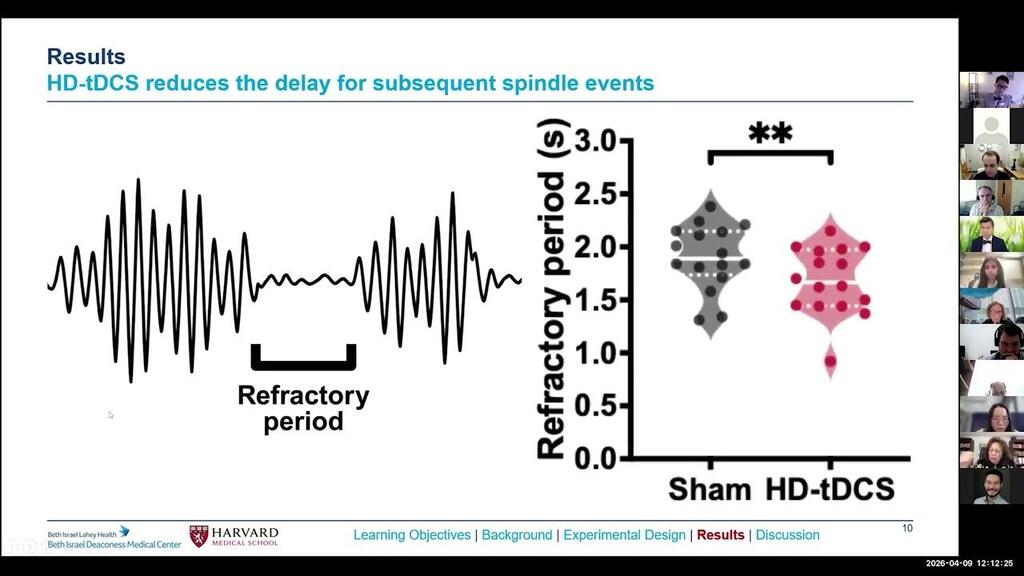
Watch: Seo Ho (Michael) Song, M.D., D.Phil., MBA presents his Clinical Fellow Scholarly Project, “Stimulating Naps: Boosting Sleep’s Restorative Potential through Neuromodulation.” This presentation examines sleep disruption as a critical endophenotype in schizophrenia and explores the feasibility of naptime non-invasive brain stimulation protocols designed to enhance sleep’s restorative effects. Dr. Song also reviews preliminary physiological and cognitive outcomes from sleep-based neuromodulation approaches.
Office of Alumni Affairs and Development
25 Shattuck Street
Boston, MA 02115